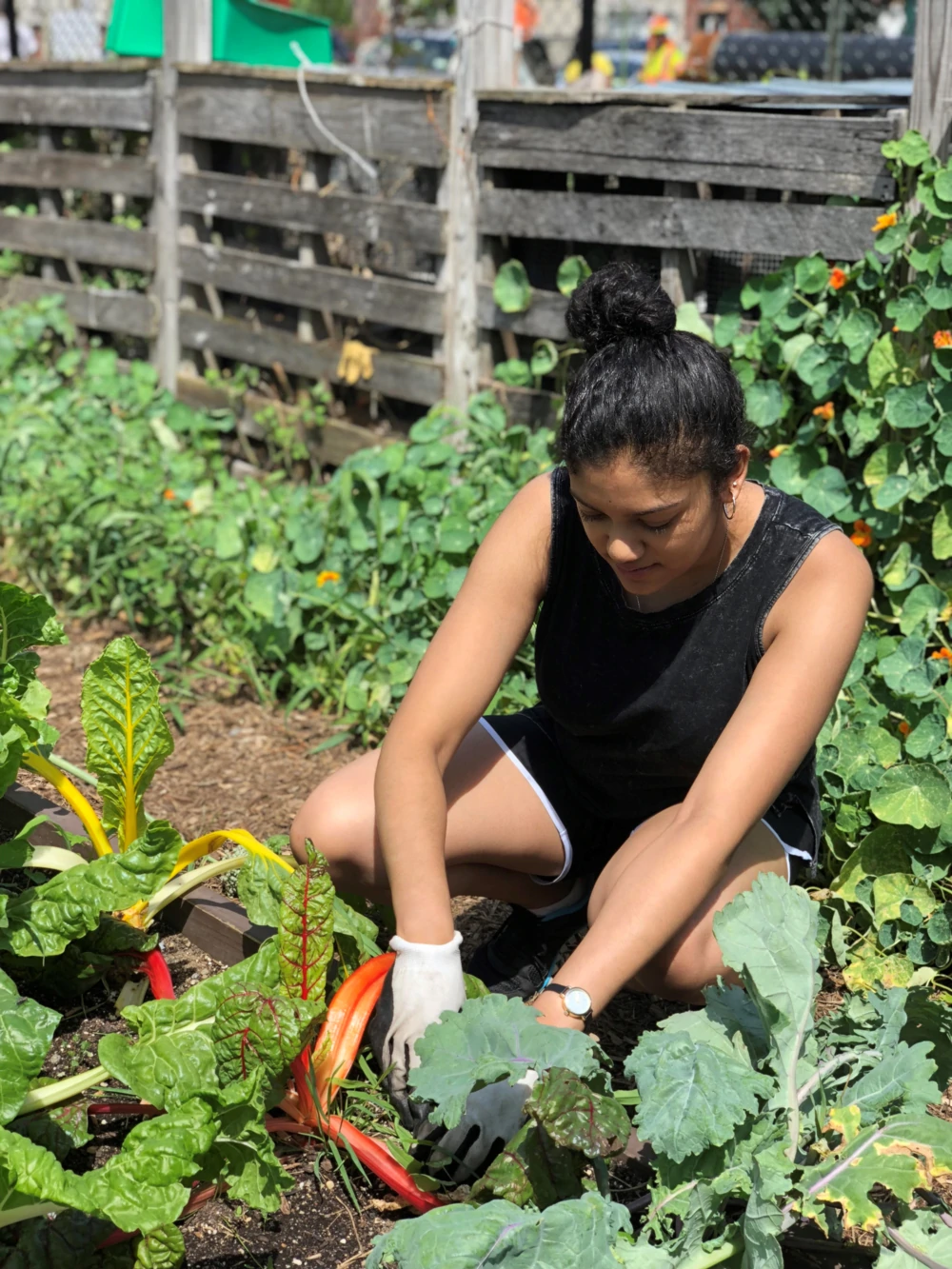
A condensed version of this Q&A with WhyHunger Executive Director Jenique Jones was originally published in Gayety under the headline “Queer Leader Jenique Jones Says Hunger Is a Policy Choice, And She’s Done Waiting.” For Pride Month, we’re sharing the full interview here.
1. You’ve spoken about growing up in Harlem. How did those early experiences shape your understanding of hunger and inequity?
For middle school, I attended school on the Upper West Side, and that experience exposed me early on to stark differences between the neighborhood I lived in and the one I was now part of during the day. In Harlem, I saw beautiful brownstones across from my apartment that were often boarded up. On the Upper West Side, those same buildings were well maintained, with flowers lining the steps. The streets were cleaner. I rarely saw crack vials. The supermarkets were full of fresh, vibrant fruits and vegetables, things that were not as accessible in my own community. And this wasn’t in a different state or even a different borough, this was 7 stops on the number 1 train yet it was like going into a different world.
It led me to start asking deeper questions. Do you have to be wealthy to live on clean streets? To have access to fresh, healthy food? Why did my grandmother and my neighbors, people who worked just as hard as anyone else, not deserve those same conditions?
As I got older, I came to understand that what I was seeing was the result of systemic disinvestment that had taken place over decades. It was about who the system chose to invest in and who it did not. That realization shaped my understanding of hunger and inequity in a fundamental way, and it continues to inform the work I do today.
2. As a queer leader, how does your identity shape the way you approach this work and community building?
My identity shapes how I see the world and how I understand both the problem and the solution. As a queer Black woman, I move through spaces where I am marginalized in society overall, but also within my own communities. As a woman in the Black community, as a Black person in queer spaces, I’ve experienced what it means to navigate systems and environments that weren’t designed with you in mind. That perspective stays with me.
It sharpens my understanding of how inequity actually shows up in people’s lives. It’s not abstract. It’s layered. It’s about who has access, who is seen, who is heard, and who is consistently pushed to the margins. And it reinforces that, if we are not intentional, even well-meaning systems and movements can replicate those same dynamics.
So, in this work, I’m very focused on being thoughtful about who is at the table, who is making decisions, and who is being resourced. It means recognizing that communities are not monolithic and that people experience hunger and poverty differently depending on their identities. It also means being willing to challenge those who sit in the majority or hold power.
At the end of the day, my identity gives me a lived understanding of what it means to navigate inequity, and that informs a leadership approach that is grounded in inclusion, accountability, and making sure that the people closest to the issue are not just included, but centered.
3. You and WhyHunger have said that “hunger is a policy choice.” What are the most urgent policy decisions right now that are impacting food access in the U.S.?
There are policy decisions right now that are having very real and immediate consequences. We’re seeing significant changes to SNAP, including reduced benefits, expanded work requirements, and shifts in eligibility that are expected to push millions of people off the program. At the same time, states are being given more authority to restrict what people can purchase, which adds inconsistency and, in many cases, stigma to how people access food. We’re also seeing increased cost burdens being shifted to states, which creates uneven access depending on where you live.
For me, the real question is whether we are willing to make different long-term policy choices. That means strengthening, not weakening, programs like SNAP. It means investing in community-led food systems, including small and BIPOC farmers. It means addressing income inequality, housing costs, and healthcare, because those are all drivers of food insecurity. Hunger is a policy choice. And if that’s true, then solving it requires moving beyond short-term fixes and making sustained, structural decisions that ensure people can consistently access and afford nutritious food.
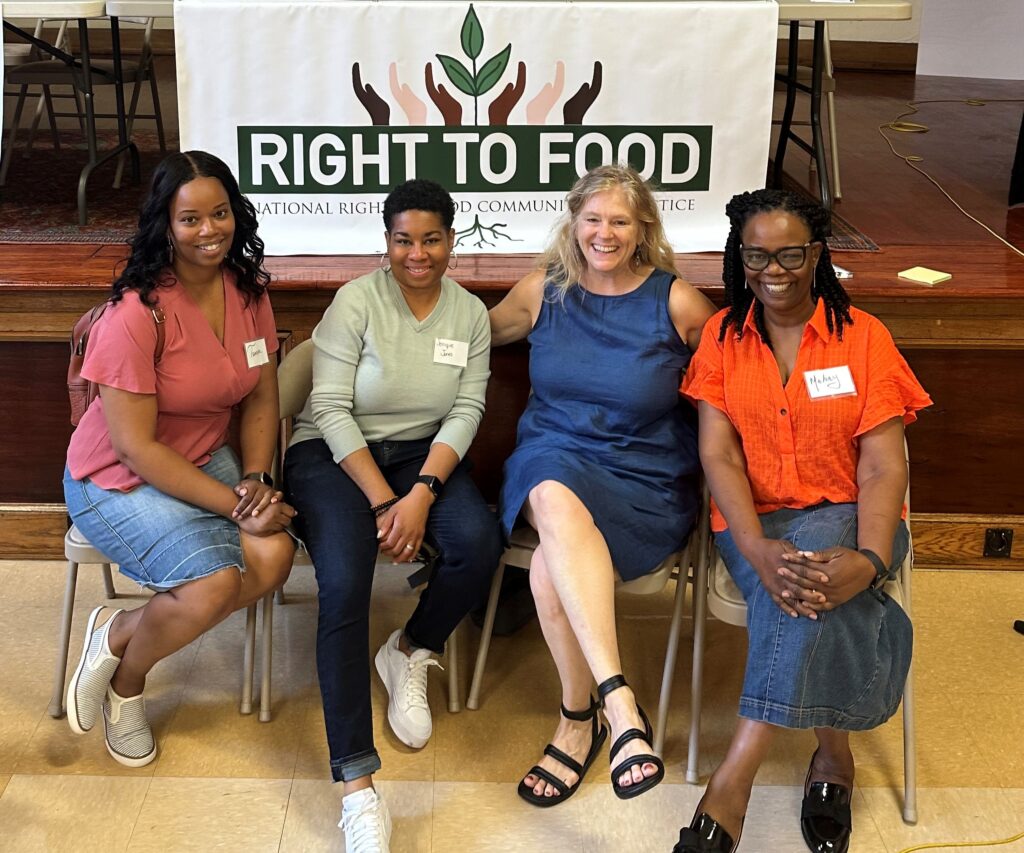
4. How do recent federal cuts and delays around the Farm Bill translate into real-life consequences for the communities you serve?
What we’re seeing with federal cuts and delays around the Farm Bill is not just a temporary setback. It’s part of a pattern of instability that makes it very difficult for communities to plan, grow, and sustain real solutions.
At a very practical level, these delays and cuts create immediate strain. Programs that communities rely on for food access, farmer support, and local infrastructure are either reduced, paused, or uncertain. That means organizations have to make tough decisions. Do they scale back programs? Do they delay hiring? Do they stop purchasing from local farmers? All of that has a ripple effect.
For the communities we work with, especially small and BIPOC farmers, this kind of uncertainty is particularly damaging. These are growers who are already navigating limited access to capital and land. When federal funding is delayed or pulled back, it can mean the difference between being able to invest in equipment, expand production, or even stay afloat. And when those farmers are impacted, the communities they serve lose access to fresh, culturally relevant food.
It’s also important to name that the Farm Bill has not historically worked well for many of the communities we serve. For small-scale producers, Indigenous communities, and Black and Brown farmers, these programs have often been difficult to access, overly complex, or structured in ways that exclude them altogether. So when funding is cut or delayed, it is not happening in a neutral system. It is compounding existing inequities and making it even harder for these communities to benefit from resources that were already out of reach.
5. WhyHunger focuses on addressing root causes rather than just symptoms, what does that look like in practice?
For us, addressing root causes means being very clear that hunger is not just about a lack of food. It’s about a lack of access, power, and resources. If we only focus on getting food to people in moments of crisis, we may meet an immediate need, but we’re not changing the conditions that created that need in the first place.
On the immediate side, we operate our national WhyHunger Hotline and Find Food tools, which help millions of people access food in their communities. That work is critical. People need to eat today. But we don’t stop there. We invest in community-led solutions that are designed to build long-term stability and power. That includes supporting small and BIPOC farmers, strengthening local food systems, and funding grassroots organizations that are addressing issues like land access, economic opportunity, and food sovereignty.
It also means looking beyond the food system itself. Hunger is tied to wages, housing, healthcare, and access to capital. So addressing root causes requires us to engage in policy and advocacy that shifts those underlying conditions, not just respond to their consequences.
And just as importantly, it means trusting the communities closest to the issue. The solutions are already there. Our role is to resource them, amplify them, and help remove the barriers that have prevented them from scaling.
6. You’ve emphasized the importance of dignity in food access. What does a more equitable and just food system actually look like?
When I talk about dignity in food access, I’m really talking about what we’ve normalized that shouldn’t be normal. We’ve created a system where people are expected to stand in line for food, sometimes for hours, just to meet a basic need. And we frame that as help. But there is indignity in that. Not just in the act itself, but in what it takes from people. That is time that could be spent resting, being with family, working, or simply having a moment of peace. Instead, people are forced to navigate long lines, limited hours, and uncertainty, just to eat.
A more equitable and just food system would not require people to prove their need or sacrifice their time and dignity to access something as fundamental as food. It would look like communities where healthy, affordable food is readily available, not something you have to travel far for or piece together from limited options. Right now, where you live still determines what you have access to. In many communities, especially low-income communities and communities of color, fresh, nutritious food is either unavailable or unaffordable. That has real consequences for health, for quality of life, and for long-term opportunity.
Dignity, for me, means consistency and choice. It means being able to walk into a store in your neighborhood and afford healthy food without having to think twice. It means not having to rely on emergency systems to meet everyday needs.
And it also means shifting how we think about solutions. Food banks and emergency food programs are important, but they were never meant to be the system. A just food system ensures that people have the income, access, and infrastructure to feed themselves and their families without relying on charity. At the end of the day, dignity looks like normalcy. It looks like people being able to meet their basic needs in ways that respect their time, their autonomy, and their humanity.
7. What are some of the most inspiring or effective community-led solutions you’ve seen through WhyHunger’s global network?
It’s hard to point to just one, because the real power of what we see through our network is in the collective. It’s in the pattern of communities, across different places and contexts, building solutions that are rooted in their own knowledge and experience. What’s inspiring is that these solutions don’t look the same everywhere, but they share a common thread. They are community-led, they are sustainable, and they’re focused on building long-term resilience, not just meeting immediate needs.
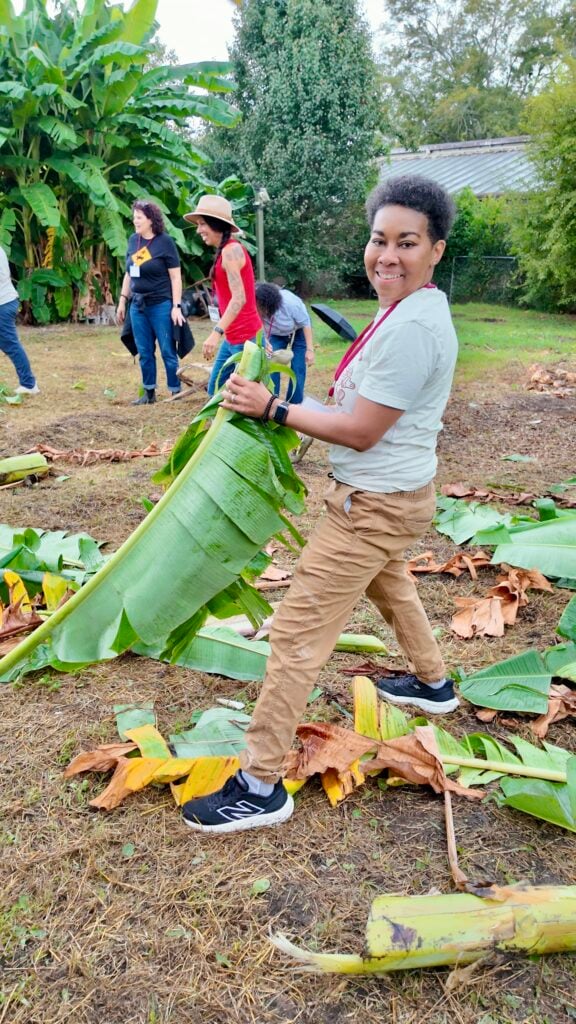
In some places, that looks like small farmers coming together to build cooperative models that increase their access to markets and income. In others, it’s Indigenous communities reclaiming land and revitalizing traditional food systems. We see grassroots organizations creating local distribution networks so food is produced and stays within the community. We see agroecology practices that are not only improving yields, but restoring land and strengthening climate resilience.
And it’s not just about food production. It’s about power. It’s about communities deciding what their food system looks like, who benefits from it, and how it’s sustained. What stands out to me is that these are not pilot ideas or short-term projects. These are solutions that have been working, often for years, and they continue to evolve because they are owned by the people closest to the issue.
8. For readers who feel overwhelmed by the scale of these issues, what are some tangible ways they can get involved or make an impact?
I understand why people feel overwhelmed. The scale of the issue can feel big, and it can feel like anything you do is too small to matter. But the reality is, this work has always been driven by collective action, not individual perfection.
There isn’t just one way to engage, and you don’t have to do everything. It starts with finding a way that feels real and sustainable for you. That can look like supporting organizations that are doing this work on the ground. It can look like using your voice, whether that’s talking about these issues, sharing information, or advocating for policies that strengthen food access and economic stability. It can look like showing up locally, supporting small farmers, mutual aid efforts, or food initiatives in your own community.
For those who want to engage directly with WhyHunger, there are a number of ways to get involved.
- You can support our work through donations, which help fund both immediate food access through our WhyHunger Hotline and Find Food tools and support our programs to scale long-term, community-led solutions.
- You can volunteer with our Hotline and be part of connecting people directly to food in their communities, which is one of the most immediate and tangible ways to make an impact.
- You can participate in our campaigns like Hungerthon, or attend events that bring people together around this work and help build a broader community of support.
- You can also share our resources so more people know how to access help when they need it. Visit our website to sign up for our newsletter or follow us and amplify our work across social media.
It’s about staying engaged. Not just when something feels urgent, but consistently. These issues don’t get solved overnight, and progress comes from sustained attention and action over time. Don’t get stuck trying to find the perfect way to help.