Skip to content

For all press inquiries, please contact:
[email protected],
Debbie DePoala at [email protected] or 212-629-0853

The founders of World Hunger Year sought to end hunger and poverty by supporting grass-roots movements and community solutions. Today, WhyHunger is known for its annual Hungerthon campaign, running this year…
Read more.
The annual health care costs associated with hunger are estimated to be $130.5 billion in the U.S. alone, showing that addressing food insecurity and poor nutrition is a necessary step…
Read more.
For a tenth consecutive year, SiriusXM will participate in WhyHunger's annual Hungerthon campaign, it was announced Wednesday (Nov. 14). The annual Thanksgiving radio tradition began in 1975, according to Hungerthon's…
Read more.
Hard Rock International is partnering with WhyHunger to release the brand's latest limited-edition merchandise line on Oct. 2. The Bruce Springsteen Signature Series: Edition 36 collection supports WhyHunger's work to…
Read more.
The social contract between our government and its people is hanging on by a thread. If the 2018 Farm Bill is any indication of the strength of that last thread,…
Read more.
Shape
Read more.
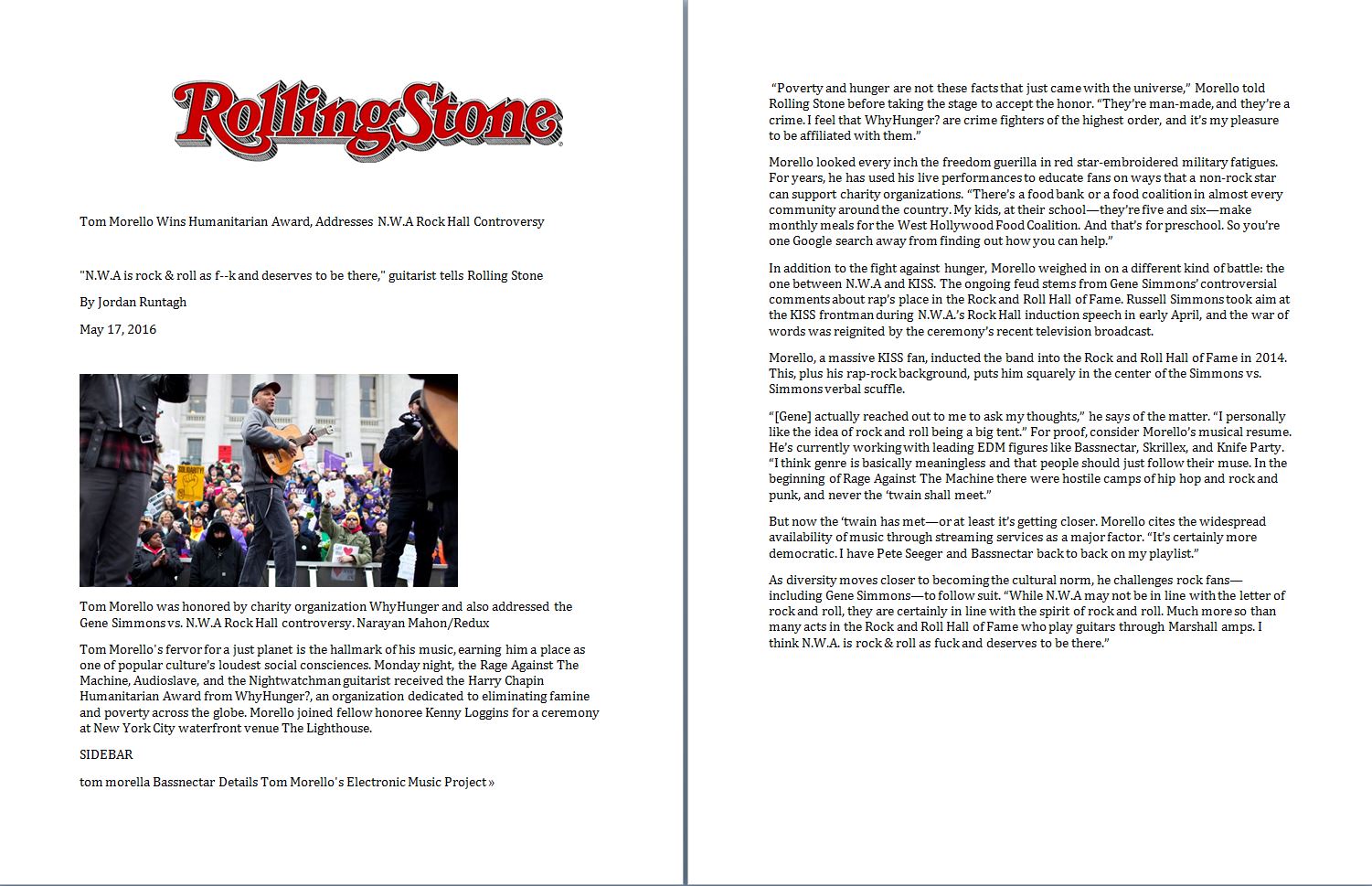
WhyHunger is in Billboard Magazine's 2016 Music + Philanthropy issue along with our partners at Food Chain Workers Alliance and longtime supporter Tom Morello.
Read more.
Interview with New York City Food Policy Center and WhyHunger Executive Director, Noreen Springstead.
Read more.
Alison Cohen, Senior Director of Programs, sits down with WNBC4 New York to share five fresh tips on how to fight hunger for the holidays.
Read more.
Alison Cohen speaks to ABC 7 Chicago about the different ways you can help end hunger.
Read more.
After a cancelled GovBall performances, Prophets of Rage dedicate proceeds from make-up show in Brooklyn, to WhyHunger.
Read more.
Q&A with recent WhyHunger Chapin Awards honoree Kenny Loggins
Read more.
Bill Ayres and Jen Chapin discuss hunger, poverty and the role we can play in finding solutions.
Read more.
Music festival hosts 15 charitable organizations on-site, including WhyHunger.  
Read more.
Socially-conscious musical shows benefit organizations like WhyHunger.
Read more.
WhyHunger's approach in working to end hunger, goes beyond charity.
Read more.
Writer Ilene Angel discusses the memorable full circle moments she had at the WhyHunger Chapin Awards.
Read more.
Emily Kinney Interview
Read more.
Talking About Food with WhyHunger Activists, Tess and Beatriz
Read more.
Southside Johnny Plays 30th Annual Hungerthon
Read more.
Emily Kinney’s Taking Over Our SnapChat for a Solid Cause  
Read more.
Emily Kinney on why watching The Walking Dead now is like going back to high school
Read more.
For Love and for the Love of Lennon in New York City: 35th Annual Tribute Concert Preview
Read more.
Deb Gordon with Suzanne Babb and Denny Marsh
Read more.
Make it Plain with Mark Thompson Broadcast Live from Bed-Stuy Campaign  Against Hunger with Alison Cohen
Read more.
Stories From Main Street: In 30th Year, Hungerthon Needed More Than Ever, Organizers Say
Read more.
It’s Hungerthon Day! Join the Fight to End Hunger in America Now
Read more.
WhyHunger featured in Family Circle's "Best Of" List for November, 2015
Read more.
Grassroots Struggle for Food Sovereignty and Liberation of Black Cultures
Read more.
Steve Adubato’s Lessons in Leadership
Read more.
Creating Harmony with WhyHunger
Read more.
Millennial Startup Founders Are the Must-Have Item This Fundraising Season
Read more.
Black and Afro-Indigenous Farmers Share 2015 Food Sovereignty Prize
Read more.
See Recent
<!--
        Hunger and climate change are two of the most pressing, interconnected issues of our time.   It is impossible to discuss the effects of climate change without addressing the crisis’s grave impacts on our existing food systems, and the environmental degradation accelerated by our current agricultural methods. As a result, issues such as hunger, poverty, and economic instability
Written by Elena Seeley As we explore organizations pursuing economic justice in the United States, we looked at the community-based work of Elijah’s Promise in New Brunswick, New Jersey. Now in its thirtieth year, what began as a soup kitchen has expanded into so much more, harnessing the power of food to end hunger and break the cycle of poverty.
        When you look at our current food system, it's easy to see the broken links between the people who produce food and the corporate and governing bodies that control its production. Too often, this results in unjust wages for rural workers, lack of economic mobility, and overall poorer livelihoods. Nicaragua’s Association of Rural Workers—Asociación de Trabajadores del Campo (ATC)—was founded in 1978.
We are excited to continue our powerful Food Justice Voices series with Comedores Sociales: An Emerging Movement in Puerto Rico. Food Justice Voices is intended to amplify the voices and experiences of grassroots leaders that aren’t heard enough, while creating awareness and educating readers on various issues connected to hunger and poverty. In this latest issue Giovanni Roberto, a social
Written by Elena Seeley   In this part of our series on economic justice, we spoke to the Food Chain Workers Alliance (FCWA). Founded in 2009, FCWA is a coalition of worker-based organizations that span all stages of the food system from planting to retail. With thirty-three members, representing over 370,000 food workers in the U.S. and Canada, FCWA works
For most farmers, farming is generally seen as a means to grow food to nourish their families as well as support populations across the globe. For some, farming can be seen as a means of defining sovereignty and sustainability for one’s self or community, working as a mechanism of social justice. For others, the act of farming goes even further,
WhyHunger believes deeply that everyone deserves the right to nutritious food and to live a life of dignity free from fear, hunger, oppression and violence. We join our allies, supporters and hundreds of thousands of advocates across the U.S. and around the world in denouncing the treatment of immigrant families and individuals fleeing a humanitarian crisis in their home countries
        Historically, Black farmers have produced food not only to feed their communities but also as a form of resistance, community building and organizing. Despite this powerful legacy, the presence and voices of Black farmers have been alarmingly absent in the national conversation about who grows our food and at the mainstream food and farming conferences in the United States.
This article was originally posted by National Family Farm Coalition.   JFK, as it turns out, was not correct when he noted 60 years ago that the word ‘crisis’ is a combination of the Chinese brush strokes meaning danger and opportunity.  While he was linguistically incorrect, we get what he was saying. A crisis situation can be the impetus for
A Q&A with Maine’s State Representative Craig V. Hickman and Quill’s End Farm owner Heather Retberg   The state of Maine has been one of the pioneering states in the U.S. working on policies to ensure its population has the adequate tools to access nutritious food through direct farmer-to-consumer transactions. In 2017 Maine passed the Food Sovereignty Law, which according
-->
        Hunger and climate change are two of the most pressing, interconnected issues of our time.   It is impossible to discuss the effects of climate change without addressing the crisis’s grave impacts on our existing food systems, and the environmental degradation accelerated by our current agricultural methods. As a result, issues such as hunger, poverty, and economic instability
Written by Elena Seeley As we explore organizations pursuing economic justice in the United States, we looked at the community-based work of Elijah’s Promise in New Brunswick, New Jersey. Now in its thirtieth year, what began as a soup kitchen has expanded into so much more, harnessing the power of food to end hunger and break the cycle of poverty.
        When you look at our current food system, it's easy to see the broken links between the people who produce food and the corporate and governing bodies that control its production. Too often, this results in unjust wages for rural workers, lack of economic mobility, and overall poorer livelihoods. Nicaragua’s Association of Rural Workers—Asociación de Trabajadores del Campo (ATC)—was founded in 1978.
We are excited to continue our powerful Food Justice Voices series with Comedores Sociales: An Emerging Movement in Puerto Rico. Food Justice Voices is intended to amplify the voices and experiences of grassroots leaders that aren’t heard enough, while creating awareness and educating readers on various issues connected to hunger and poverty. In this latest issue Giovanni Roberto, a social
Written by Elena Seeley   In this part of our series on economic justice, we spoke to the Food Chain Workers Alliance (FCWA). Founded in 2009, FCWA is a coalition of worker-based organizations that span all stages of the food system from planting to retail. With thirty-three members, representing over 370,000 food workers in the U.S. and Canada, FCWA works
For most farmers, farming is generally seen as a means to grow food to nourish their families as well as support populations across the globe. For some, farming can be seen as a means of defining sovereignty and sustainability for one’s self or community, working as a mechanism of social justice. For others, the act of farming goes even further,
WhyHunger believes deeply that everyone deserves the right to nutritious food and to live a life of dignity free from fear, hunger, oppression and violence. We join our allies, supporters and hundreds of thousands of advocates across the U.S. and around the world in denouncing the treatment of immigrant families and individuals fleeing a humanitarian crisis in their home countries
        Historically, Black farmers have produced food not only to feed their communities but also as a form of resistance, community building and organizing. Despite this powerful legacy, the presence and voices of Black farmers have been alarmingly absent in the national conversation about who grows our food and at the mainstream food and farming conferences in the United States.
This article was originally posted by National Family Farm Coalition.   JFK, as it turns out, was not correct when he noted 60 years ago that the word ‘crisis’ is a combination of the Chinese brush strokes meaning danger and opportunity.  While he was linguistically incorrect, we get what he was saying. A crisis situation can be the impetus for
A Q&A with Maine’s State Representative Craig V. Hickman and Quill’s End Farm owner Heather Retberg   The state of Maine has been one of the pioneering states in the U.S. working on policies to ensure its population has the adequate tools to access nutritious food through direct farmer-to-consumer transactions. In 2017 Maine passed the Food Sovereignty Law, which according

All publications